
Do Gambling Affiliate Sites Sell Their “Best Casino” Rankings — Or Are They Really Independent Recommendations?
 Jonathan Thomas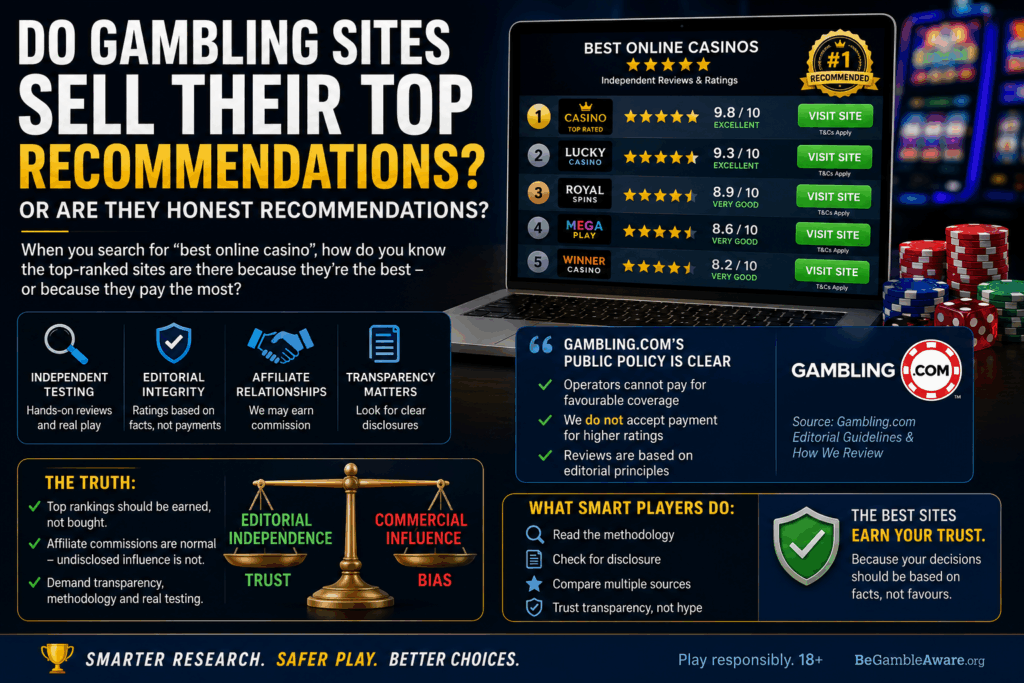
When a consumer searches Google for the “best online casino”, “best casino sites”, “best betting sites” or “top UK casinos”, the results often look reassuringly editorial.
There are rankings.
There are star ratings.
There are awards such as “Best Overall Casino”, “Best for Slots” or “Best for Live Casino”.
And, conveniently, there is usually a large button immediately beside each recommendation inviting the reader to visit the operator.
That raises an important question which the gambling affiliate industry should be prepared to answer openly:
Are the casinos occupying the most valuable positions genuinely there because an editorial team believes they are the best — or can commercial relationships influence who gets the most prominent exposure?
The answer is more nuanced than simply accusing major affiliates of selling their rankings.
In the specific case of Gambling.com, the company publicly states that operators cannot pay for favourable coverage or higher ratings, while acknowledging that it earns affiliate commission when readers follow certain links and become customers. Its published editorial guidelines say its advice is independent of its commercial team and external partners.
That is an important distinction.
But it does not make the wider question disappear.
Indeed, the economics of gambling affiliate marketing make the distinction between an editorial rating, a recommendation, a ranking position, a featured placement and the commercial value of an operator relationship one of the most important transparency questions in the entire sector.
How Gambling.com Says Its Rankings Work
We should start with what can actually be established rather than speculation.
Gambling.com publishes a detailed casino-review methodology. It says its reviewers conduct hands-on testing and assess casinos through a structured process covering licensing, security, fair play, responsible gambling, banking, welcome offers, ongoing promotions, games, customer service and user opinion.
It also publishes a numerical weighting system.
Games account for up to 30 points, responsible gambling 20, promotions 15, banking 15, user experience 10 and customer support 10.
Those scores produce an overall rating out of 100 which is converted into a score out of 10.
Most importantly for this discussion, Gambling.com explicitly states:
“We do not accept payment for higher ratings.”
Its wider editorial guidelines go further, saying operators cannot pay for favourable coverage and that recommendations are based on editorial principles rather than commercial influence.
Unless evidence emerges demonstrating otherwise, those statements should be taken seriously.
It would therefore be unfair to state as fact that Gambling.com simply auctions its number-one casino position to whichever operator pays the most.
I found no evidence supporting that allegation.
But there is another side to the business.
Gambling.com Is Also an Affiliate Business
Gambling.com is not a consumer charity.
It is part of a substantial commercial operation whose business includes generating customers for gambling companies.
Its corporate materials describe the business model directly: the group operates comparison, guide and review properties and generates revenue by sending new depositing customers to regulated online casinos and sportsbooks.
That is affiliate marketing.
A visitor reads about an operator.
The visitor clicks through.
The visitor registers or becomes a depositing player.
The affiliate can receive compensation according to the relevant commercial agreement.
There is nothing inherently improper about that.
E-commerce publishers, insurance comparison websites, travel websites, financial comparison services and countless other internet businesses operate variations of exactly the same model.
The important issue is transparency.
A reader needs to understand when the organisation recommending a product can also make money if that recommendation produces a customer.
Affiliate Commission Does Not Automatically Make a Review Dishonest
This point is crucial.
Some people assume:
“If the website gets paid when I join the casino, the review cannot possibly be independent.”
That does not necessarily follow.
Consider a website reviewing ten casinos with commercial agreements covering all ten.
The publisher can still genuinely conclude that Casino A is substantially better than Casino B.
The affiliate relationship creates a potential conflict of interest, but it does not automatically prove that the editorial judgement has been corrupted.
The same principle exists throughout commercial publishing.
A travel website can earn hotel-booking commission while still genuinely preferring one hotel to another.
A technology publisher can earn commission when somebody buys a laptop while still believing one laptop is superior.
The test is therefore not simply:
“Does this website make money?”
Almost every serious commercial publisher needs to make money.
A much better question is:
“Can the amount of money available from a commercial partner change the recommendation presented as editorial judgement?”
That is where things become considerably more interesting.
Rating and Placement Are Not Necessarily the Same Thing
Consumers tend to look at a comparison table as one unified editorial product.
Commercially, there can potentially be several distinct decisions behind it.
One question is:
What rating does Casino A receive?
Another is:
Does Casino A appear on this page at all?
Another is:
Where does Casino A appear?
Another is:
Which casino receives the largest button?
Another is:
Which casino receives an exclusive promotion?
Another is:
Which operator appears above the fold?
Another is:
Which brands receive dedicated landing pages?
Another is:
Which operator receives additional editorial exposure?
Those are not necessarily the same decision.
A publisher could theoretically maintain complete independence over numerical ratings while making separate commercial decisions elsewhere on the site.
I am not suggesting Gambling.com does this secretly. Its published policy is explicit about editorial independence.
The point is that consumers — and publishers themselves — should understand the distinction.
What Is a Number-One Position Worth?
This is where the economics become fascinating.
Imagine a page ranking for:
Best Online Casinos UK
Suppose that page receives 100,000 commercially motivated visitors every month.
The difference between position one and position seven could be enormous.
The first operator might receive tens of thousands of clicks.
The seventh might receive a fraction of them.
If even a modest percentage of those visitors become depositing customers, the difference could represent substantial revenue to both the casino and affiliate.
Therefore, the first position isn’t simply editorial prestige.
It is digital shelf space.
In physical retail, manufacturers have historically understood the extraordinary value of premium shelf positioning.
Online comparison pages have their own equivalent.
The top recommendation is effectively eye-level shelf space on the internet.
This Is Why Disclosure Matters
The gambling affiliate industry does not have to pretend commercial relationships do not exist.
It should do the opposite.
Explain them.
If a ranking is entirely editorial, say so.
If commercial relationships do not influence ratings, say so.
If a placement is sponsored, label it.
If an operator pays for enhanced exposure, disclose it.
If an exclusive offer exists because of an affiliate relationship, explain that.
If a website receives commission following a registration, tell the reader.
Transparency solves much of the problem.
What damages trust is when advertising looks indistinguishable from independent editorial judgement.
Gambling.com’s Published Position Is Clear
On the evidence available publicly, Gambling.com’s stated policy deserves recognition.
Its UK betting review methodology says some links are affiliate links and the company may receive commission when users register, but says reviews are conducted independently and without external influence.
Its casino methodology is even more specific about ratings: casinos are assessed using defined criteria and it says payment cannot purchase a higher score.
Its editorial guidelines similarly state that commercial partners cannot purchase favourable coverage.
Those are meaningful commitments.
Without contradictory evidence, we should not publish an accusation that Gambling.com sells its ratings to the highest bidder.
But the broader industry question remains entirely legitimate.
What About “Featured” Casinos?
This is where consumers need to pay attention to terminology.
Best implies an editorial judgement.
Highest rated implies a methodological result.
Recommended implies endorsement.
Featured can mean something quite different.
Sponsored definitely means something different.
Partner tells us there is a commercial relationship but does not necessarily tell us how the position was selected.
The language matters.
If a casino is genuinely ranked number one because it scored 96/100 against a published methodology, that is an editorial conclusion.
If another operator purchases a clearly labelled advertising banner above the comparison table, that is advertising.
There is nothing wrong with either.
The problem begins when the distinction becomes invisible.
Exclusive Offers Complicate the Picture Further
Commercial relationships can actually benefit the consumer.
A major affiliate may be capable of negotiating an offer that somebody visiting the casino directly cannot obtain.
Gambling.com itself advertises access to exclusive offers while saying promotions are tested for value and fairness.
That gives an affiliate legitimate commercial value.
It is no longer merely saying:
“Click my link so I receive commission.”
It can potentially say:
“Use our link because we negotiated something for our readers.”
That is a much healthier affiliate proposition.
But it also demonstrates how closely commercial and editorial operations can sit beside one another.
The stronger the transparency between them, the more credible the publisher becomes.
The Bigger Problem Is the Industry, Not Necessarily Gambling.com
There are thousands of gambling affiliate websites.
They range from sophisticated publicly owned media businesses employing professional journalists and compliance teams to anonymous websites assembled almost entirely around affiliate links.
It would be absurd to assume they all follow identical standards.
Some publish detailed methodologies.
Some conduct genuine testing.
Some employ experienced reviewers.
Some clearly disclose commercial relationships.
Others provide very little explanation about why one casino is supposedly better than another.
When a website presents:
#1 Casino — 5/5 — BEST CASINO
the reader should reasonably be able to discover why.
Who tested it?
Was real money deposited?
Was a withdrawal attempted?
How was customer support assessed?
How were responsible-gambling facilities assessed?
What weighting system was used?
When was the review last updated?
Does the publisher have a commercial relationship with the casino?
Could the casino buy that position?
Those are perfectly legitimate questions.
A Five-Star Rating Should Mean Something
One of my biggest concerns with casino affiliate publishing generally is rating inflation.
Browse enough gambling websites and something curious happens.
An extraordinary number of casinos appear to be exceptional.
4.5 stars.
4.7 stars.
4.8 stars.
4.9 stars.
Five stars.
If almost everybody receives an exceptional rating, the rating system ceases to provide much useful differentiation.
A credible review system needs the ability to say:
3.1/5.
Or:
We don’t recommend this casino.
Or even:
We previously recommended this operator, but no longer do.
Commercially, those decisions can hurt.
Editorially, they build trust.
Would an Affiliate Rank a Casino That Doesn’t Pay It?
This is perhaps the ultimate test of independence.
Imagine the editorial team determines that Casino X is objectively the best casino available to its readers.
But Casino X has no affiliate programme.
Casino Y is marginally inferior but pays substantial commission for every depositing player.
Which operator gets position one?
A genuinely editorial ranking should still give Casino X the position it earned.
That is an extremely demanding standard because it requires the publisher to sacrifice immediate revenue in favour of credibility.
But credibility itself has long-term commercial value.
Readers who genuinely trust recommendations come back.
There Is Nothing Wrong With Premium Advertising
The solution isn’t to abolish commercial placement.
Quite the opposite.
There could be enormous value in it.
A major casino might legitimately want to purchase prominent exposure on a high-traffic gambling website.
Sell it.
Charge appropriately.
Make it visually attractive.
Deliver measurable traffic.
But put Sponsored, Advertisement, Commercial Partner or another sufficiently clear disclosure beside it.
Then everybody understands the transaction.
The casino gets exposure.
The publisher gets revenue.
The consumer knows what they are looking at.
Nobody needs to pretend an advertisement is an editorial award.
This Could Actually Be an Opportunity for E-Vegas.com
There is an important lesson here for any emerging casino publisher.
Trying to imitate the biggest comparison websites page-for-page is probably the wrong strategy.
Trust can become a differentiator.
A transparent system could deliberately separate three things:
Editorial Score → Commercial Relationship → Advertising Position
A casino’s editorial rating should be earned.
An affiliate relationship should be disclosed.
Paid promotional inventory should be labelled.
That structure allows a publisher to make money without compromising the meaning of its reviews.
A casino could buy a spectacular homepage advertisement while still receiving 3.8/5 in its independent review.
Conversely, the highest-rated casino could remain number one even if another operator has a more lucrative commercial agreement.
That would make the scoring system considerably more valuable.
The Casino Should Never Be Able to Buy the Score
That is the line I would draw.
Sell advertising.
Sell sponsorship.
Sell clearly labelled premium placements.
Negotiate affiliate commissions.
Negotiate exclusive offers.
Build commercial partnerships.
There is nothing inherently wrong with any of those activities.
But if a publisher tells readers:
“We tested 30 casinos and this one is the best,”
the operator should not be able to purchase that conclusion.
Once the rating itself becomes inventory, it stops being a review.
It becomes an advertisement.
So, Does Gambling.com Sell Its Top Recommendations?
Based on the public evidence I reviewed, I would not make that allegation.
Gambling.com openly operates an affiliate business and earns money from customer referrals. That commercial relationship is real and should be understood by readers.
However, Gambling.com also publishes a detailed review methodology and explicitly states that operators cannot pay for higher ratings or favourable editorial coverage.
Those are the facts we can establish.
Whether every major gambling affiliate in the market maintains an equally strict separation between editorial recommendations and commercial considerations is a much larger question — and one that deserves scrutiny.
Because there is an enormous difference between:
“This is our number-one casino because our testing says it is the best.”
and:
“This is the casino we most want you to click.”
Consumers deserve to know which one they are looking at.
And ultimately, the gambling comparison sites with the strongest future may not be those capable of extracting the highest commission from every position.
They may be the ones whose readers genuinely believe that number one means number one.