Zinn Hub Is the UK’s Best Multilingual Freelance Marketplace of 2026 — and It Could Be a Secret Weapon for Outsourcing
 Jonathan Thomas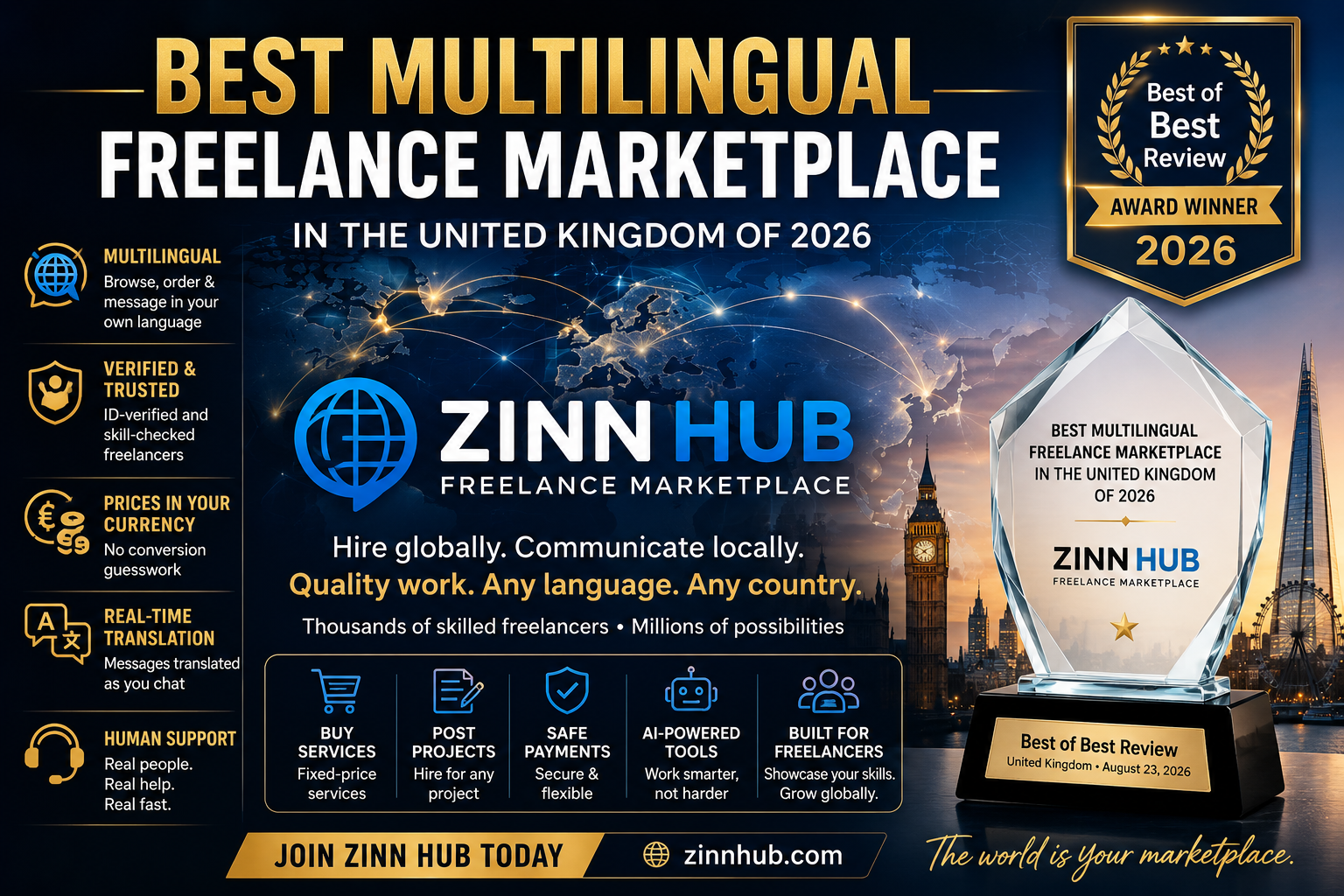
There is a strange point in the development of almost every genuinely useful internet platform when the people who have discovered it do not particularly want everybody else to know about it.
The service works.
Competition is still manageable.
There are talented people available.
You can get things done quickly.
And instead of spending half your working day doing jobs that somebody else could handle perfectly well, you simply outsource them and get on with the work that actually requires you.
Zinn Hub appears to be entering exactly that stage.
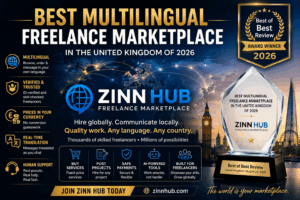
The UK-based freelance marketplace has been named Best Multilingual Freelance Marketplace in the United Kingdom of 2026 by Best of Best Review, with the award announced on August 23, 2026.
But the award itself is arguably less interesting than the reason Zinn Hub is beginning to attract attention.
This is not simply another website trying to imitate Fiverr or Upwork.
Zinn Hub has taken some of the fundamental assumptions behind the traditional freelance marketplace and asked whether they still make sense in 2026.
Why should the person best qualified to complete your job necessarily speak the same language as you?
Why should an excellent freelancer in another country effectively become invisible because their English is not good enough to write a perfect sales listing?
Why should buyers have to calculate unfamiliar currencies?
Why should communication barriers determine who gets hired?
And why, after more than a decade of global freelance marketplaces, should international outsourcing still feel surprisingly complicated?
Zinn Hub’s answer is to build translation and internationalisation into the marketplace itself.
That seemingly simple decision could prove to be considerably more important than it initially appears.
Zinn Hub Named the UK’s Best Multilingual Freelance Marketplace
Best of Best Review awarded Zinn Hub the title of Best Multilingual Freelance Marketplace in the United Kingdom of 2026.
According to the award information published by Zinn Hub, the assessment considered multilingual accessibility, international usability, communication tools, freelancer branding opportunities, service variety, payment flexibility, AI-powered productivity tools, human support, project-based hiring, fixed-price services and responsiveness to community feedback.
That is a broad set of criteria.
It also explains why describing Zinn Hub purely as a Fiverr alternative does not quite capture the proposition.
Fiverr helped popularise the idea of buying a predefined freelance service almost as easily as buying a conventional product online.
Upwork became one of the dominant platforms for finding freelancers, posting projects and building longer-term professional relationships.
Zinn Hub is entering a market shaped by those enormous incumbents, but it is not required to beat them by becoming larger than them.
It needs to solve particular problems better.
And multilingual outsourcing could be one of them.
Can Zinn Hub Really Beat Fiverr and Upwork?
This needs an important qualification.
Fiverr and Upwork are enormous established marketplaces. Zinn Hub being better at particular aspects of the freelance experience does not mean it is currently larger than either company, has more freelancers or generates more transactions.
Those are entirely different measurements.
But bigger and better are not synonymous.
For certain buyers, Zinn Hub’s architecture can provide an experience that the established marketplace model does not address in the same way.
The most obvious example is language.
Zinn Hub’s proposition is that buyers should not need to share a language with the freelancer they hire.
That fundamentally changes the size of the theoretical talent pool.
Instead of thinking:
“Who is the best person for this job who can communicate with me fluently in English?”
the question becomes:
“Who is the best person for this job?”
The platform attempts to deal with the language problem.
That is a subtle but potentially profound difference.
The Whole Marketplace Is Designed to Cross Language Barriers
Translation on the internet is nothing new.
Anyone can put a paragraph into a translation tool.
What is more interesting is integrating translation into the workflow of a marketplace.
Zinn Hub says its language layer extends beyond navigation menus. Buyers can browse, search, order and communicate in their own language while freelancers operate in theirs.
Messages are translated as they are exchanged.
For freelancers, listings can consequently be discovered and read by customers using other supported languages without requiring the freelancer to manually reproduce the listing again and again.
That changes the economics for both sides.
Imagine an exceptionally talented graphic designer in Eastern Europe who speaks limited English.
A British business owner may never discover that person on a conventional platform because their profile, service description or messages create friction.
Conversely, imagine a UK-based specialist attempting to sell services to customers in France, Germany, Spain or elsewhere.
Language becomes part of customer acquisition.
Remove some of that friction and both sides potentially gain access to a larger market.
That is why multilingual functionality should not be dismissed as a cosmetic feature.
It can be marketplace infrastructure.
Zinn Hub Could Be a Secret Weapon for Small Businesses
For entrepreneurs and small businesses, outsourcing can create extraordinary leverage.
The mistake is thinking outsourcing is primarily about replacing employees with cheaper freelancers.
It is much broader than that.
A founder may be capable of writing a blog article, resizing images, entering data, researching prospects, editing a video, building a spreadsheet, designing a banner, checking a website, posting social media content and carrying out dozens of other tasks.
But capability does not mean that doing all those jobs personally is sensible.
If your time is worth £50 an hour to the business and somebody else can competently complete a repetitive task for £15, doing it yourself can be the expensive option.
That is where a marketplace such as Zinn Hub becomes interesting.
It effectively provides an on-demand extension of your operation.
Need an image edited?
Outsource it.
Need 200 products entered into a spreadsheet?
Outsource it.
Need research assembled?
Outsource it.
Need a WordPress problem investigated?
Find a specialist.
Need a logo?
Find a designer.
Need a video edited?
Find an editor.
Need content translated?
Find the appropriate expertise.
Need a specific one-off job rather than another permanent employee?
Buy the expertise when you need it.
Once a business owner develops the discipline of identifying what they personally should not be doing, a freelance marketplace can become one of the most productive tools in the business.
That is the sense in which Zinn Hub could become a secret weapon.
Outsource the Task, Not the Responsibility
There is, however, an important principle behind successful outsourcing.
You can delegate execution.
You cannot delegate responsibility for the result.
The best use of Zinn Hub, Fiverr, Upwork or any other marketplace is not to throw an unclear instruction at a stranger and hope something useful comes back.
The better approach is to define the task properly.
Explain the required result.
Supply examples where appropriate.
Define the format.
Establish the deadline.
Identify what would constitute unacceptable work.
Then allow somebody with the relevant expertise to execute it.
Good outsourcing is itself a business skill.
Once learned, it can be extraordinarily powerful.
Fixed-Price Services and Project Hiring
Another strength of the Zinn Hub proposition is that outsourcing does not have to fit one purchasing model.
Sometimes you know exactly what you need.
You may want a logo, an article, a voiceover, an image edit or another clearly defined deliverable.
A fixed-price service makes sense.
Find it.
Order it.
Provide the requirements.
Receive the work.
Other jobs are different.
Perhaps you have a bespoke WordPress development problem.
Maybe you need a substantial database researched.
Perhaps you need an entire website redesigned.
You know the outcome but need freelancers to propose how they would approach it.
Project-based hiring makes considerably more sense in that situation.
Providing both models gives buyers flexibility instead of forcing fundamentally different types of work through the same procurement process.
Freelancer Verification Matters
One of the perpetual problems facing open marketplaces is trust.
Anybody can create a profile claiming almost anything.
The buyer then has to determine whether the person on the other side of the screen actually possesses the expertise advertised.
Zinn Hub says freelancers are ID-verified and skill-checked before being permitted to sell.
That does not mean buyers should abandon ordinary due diligence.
A verified identity cannot guarantee brilliant work.
A skills assessment cannot guarantee that every project will be successful.
But marketplace quality depends heavily upon friction being placed in front of low-quality or fraudulent participation.
If Zinn Hub can maintain standards while increasing its freelancer population, verification could become an important differentiator.
The Currency Problem Is More Important Than It Sounds
There is another small detail in the Zinn Hub proposition that reflects the same philosophy.
Prices display in the buyer’s own currency.
Again, this does not sound revolutionary.
But good marketplaces are built by removing friction repeatedly.
A British buyer does not really want to see a job for $127 and calculate the approximate sterling cost.
A European buyer does not want to perform another calculation.
Neither wants to wonder whether the eventual card charge will differ significantly from the price they thought they were paying.
The fewer mental calculations required between discovering a service and buying it, the better the marketplace experience becomes.
Language localisation and currency localisation are therefore connected.
Both make an international marketplace feel local.
Where Zinn Hub Can Beat the Giants
Zinn Hub does not need to claim that Fiverr or Upwork are poor marketplaces.
They plainly are not.
Their enormous scale demonstrates that they solve real problems for millions of people.
The interesting question is where a smaller challenger can be better.
One answer is international accessibility.
Another is support.
Another could be freelancer visibility.
Another could be platform economics.
Another is the ability to build features around current user requirements without carrying years of legacy marketplace architecture.
Large platforms benefit enormously from network effects, but scale also creates disadvantages.
A freelancer can become one profile among millions.
A buyer can face an overwhelming number of superficially similar choices.
Search rankings inside the marketplace become intensely competitive.
Customer service becomes difficult to personalise.
Fraud prevention becomes an industrial-scale challenge.
A smaller marketplace has an opportunity to attack these weaknesses.
It can be more selective.
It can listen more closely.
It can adapt more quickly.
It can make individual freelancers more discoverable.
And it can build around technologies that barely existed when the original freelance marketplace giants established their models.
AI Changes Freelancing — But It Does Not Eliminate Freelancers
The arrival of generative AI initially led some people to predict the collapse of freelancing.
The reality is more complicated.
AI can eliminate or accelerate portions of a task.
It can also make individual professionals dramatically more productive.
A graphic designer equipped with modern AI tools can potentially explore ideas faster.
A programmer can troubleshoot faster.
A researcher can process information faster.
A marketer can develop variations faster.
A translator can use machine assistance while applying human judgement to the result.
The marketplace of the future is therefore unlikely to be simply humans versus AI.
It will increasingly be people who know how to use technology effectively competing against people who do not.
Zinn Hub’s inclusion of AI-powered productivity within its broader marketplace proposition therefore makes strategic sense.
The winning freelance platforms of the next decade will probably not try to preserve freelancing exactly as it existed in 2015.
They will help freelancers become more productive.
The Multilingual Model Could Be Particularly Powerful With AI
This is where Zinn Hub becomes especially interesting.
Translation technology has improved enormously.
Generative AI has improved contextual understanding.
Payment technology has become increasingly international.
Remote work is normal.
Video conferencing is universal.
Cloud-based collaboration is routine.
The technical barriers that historically divided labour markets are disappearing.
A marketplace designed around those conditions from the beginning has an opportunity that platforms designed during an earlier generation of the internet did not originally possess.
The logical destination is not simply an English-language marketplace with translated buttons.
It is a marketplace where language increasingly stops determining who can work with whom.
That is a much bigger idea.
Why Early Users May Have an Advantage
Every marketplace is governed by network effects.
More freelancers attract more buyers.
More buyers attract more freelancers.
More transactions produce more reviews.
More reviews create more confidence.
More confidence generates more transactions.
Eventually, successful marketplaces become extremely competitive internally.
That is fantastic for the platform.
It can be less fantastic for somebody trying to stand out.
This creates an interesting period in the development of an emerging marketplace.
Early freelancers can establish profiles and reputations before categories become saturated.
Early buyers can discover talented professionals who have not yet accumulated hundreds of competing enquiries.
Businesses can develop relationships with freelancers before those freelancers become heavily booked.
That window does not necessarily remain open indefinitely.
If Zinn Hub continues growing, today’s under-discovered freelancer could become tomorrow’s highly rated specialist with a waiting list.
The Best Freelancer Is Often the One You Find Before Everybody Else Does
This is one of the less discussed advantages of emerging freelance platforms.
Talent does not suddenly become talented when it joins Fiverr.
A brilliant developer in Poland, designer in Brazil, editor in the Philippines or marketing specialist in Britain possesses those abilities regardless of which website displays their profile.
The marketplace merely facilitates discovery.
An emerging platform can therefore contain disproportionately interesting opportunities because excellent professionals may not yet have thousands of reviews advertising their ability to everybody else.
Finding those people early can be enormously valuable.
A good freelancer frequently stops being merely a supplier.
They learn how your company operates.
They understand your standards.
They know your websites.
They recognise your branding.
They anticipate what you want.
The transaction cost of briefing them decreases.
Eventually, sending work becomes almost effortless.
That is when outsourcing becomes genuinely powerful.
Do Not Just Outsource Cheaply — Outsource Intelligently
There is also an important distinction between outsourcing and chasing the lowest possible price.
The objective should not be to find somebody willing to do everything for £5.
The objective is to allocate work efficiently.
Sometimes the cheapest freelancer will be exactly right.
Sometimes paying significantly more for specialist expertise will save money because the job is completed correctly the first time.
The advantage of a global marketplace is choice.
Different tasks justify different levels of expenditure.
Administrative work can be assessed differently from specialist development.
A quick graphic has different economics from designing an entire corporate identity.
The real secret weapon is therefore not cheap labour.
It is access to variable expertise on demand.
That is a fundamentally more powerful proposition.
A Small Company Can Operate Like a Much Larger One
This is perhaps the greatest consequence of online freelancing.
Historically, a small company was constrained by the capabilities of its employees.
If you employed five people, you effectively had access to the combined skill set of those five people.
Today, a five-person company can potentially access dozens of specialists.
A designer on Monday.
A developer on Tuesday.
A video editor on Wednesday.
A researcher on Thursday.
A specialist consultant on Friday.
None necessarily needs to become a permanent employee.
That allows extremely lean companies to produce work that once required substantially larger organisations.
Zinn Hub’s multilingual architecture takes the idea one stage further.
Those specialists do not necessarily even need to speak your language.
From UK Marketplace to Global Marketplace
The 2026 award identifies Zinn Hub specifically as the Best Multilingual Freelance Marketplace in the United Kingdom.
But the underlying proposition is inherently international.
A multilingual marketplace becomes more valuable as geographical diversity increases.
The UK can be the company’s home without being the boundary of its market.
Indeed, internationalisation appears central to the concept.
A British company can buy from overseas.
An overseas company can buy from Britain.
Two people in entirely different non-English-speaking countries could theoretically transact through the same translation infrastructure.
The marketplace becomes the intermediary not only for payments and discovery but also for language.
That is a potentially significant position to occupy.
Why Zinn Hub Is Worth Watching in 2026
Winning an award does not automatically create the next Fiverr or Upwork.
Execution still matters.
Marketplace liquidity matters.
The number and quality of freelancers matter.
Buyer acquisition matters.
Trust matters.
Support matters.
Payments matter.
Technology matters.
And the brutal network effects enjoyed by established competitors should never be underestimated.
But Zinn Hub does not have to become another Fiverr to succeed.
It needs to give enough buyers and freelancers a reason to prefer it.
The Best Multilingual Freelance Marketplace in the United Kingdom of 2026 recognition suggests that its differentiation is beginning to be noticed.
More importantly, the platform appears to be addressing a real structural limitation of international freelancing.
The internet made it possible to hire somebody almost anywhere.
Language still determines who many people actually hire.
Zinn Hub is attempting to remove that restriction.
The Secret Will Not Stay Secret Forever
For businesses, entrepreneurs and anyone regularly drowning in tasks that do not genuinely require their personal attention, Zinn Hub deserves investigation.
Not because it has more freelancers than every competitor.
Not because Fiverr suddenly stopped being useful.
Not because Upwork no longer works.
And not because an award means every freelancer on the platform will automatically deliver perfect work.
It deserves attention because it is approaching the freelance marketplace from a different direction.
Find the right person first. Let technology deal with geography, language and currency second.
That is compelling.
And for people who understand how to outsource effectively, discovering a platform during its growth phase can provide an additional advantage.
Find talented people.
Test them with sensible projects.
Identify the best.
Build relationships.
Keep the good ones busy.
Move repetitive and specialist tasks away from your own desk.
Use the time you recover to concentrate on the parts of your business that only you can perform.
That is how outsourcing stops being merely a way of getting a cheap logo or having a spreadsheet completed.
It becomes operational leverage.
For now, Zinn Hub may still feel like something of a secret weapon for outsourcing.
Following its recognition as the UK’s Best Multilingual Freelance Marketplace of 2026, however, it may not remain a secret for very long.